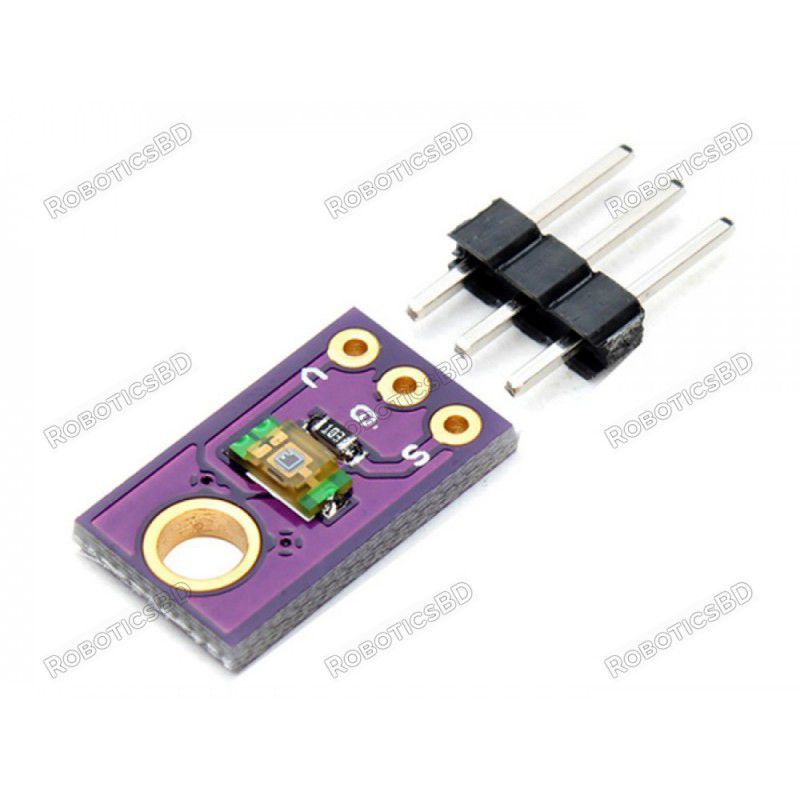
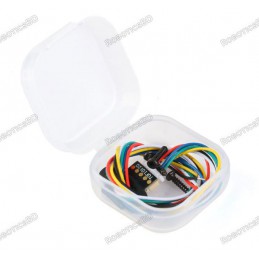
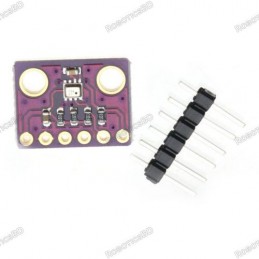
The TEMT6000 Ambient Light Sensor Module is a compact and efficient solution for measuring visible light intensity and converting it into a proportional analog voltage. Designed with peak sensitivity at 570nm, this sensor closely matches the response of the human eye, making it ideal for ambient light detection and brightness control. Its wide detection angle of ±60° and fast microsecond-level response enable accurate real-time measurements. With a working range of 10 to 1000 lux, it is suitable for applications from dim indoor lighting to outdoor conditions. Compatible with both 3.3V and 5V systems, the TEMT6000 is widely used in automatic backlight dimming, environmental monitoring, smart lighting, and DIY microcontroller-based projects. Featured By RoboticsBD.
Product Images are shown for illustrative purposes only and may differ from the actual product.
RoboticsBD RoboticsBD RoboticsBD RoboticsBD RoboticsBD RoboticsBD RoboticsBD RoboticsBD RoboticsBD RoboticsBD
Features:
Visible light detection with peak sensitivity at 570nm (human-eye-like response).
Wide detection angle of ±60° for accurate ambient measurements.
Linear analog voltage output proportional to light intensity.
Fast response time in the microsecond range for dynamic lighting conditions.
Wide operating range: reliable from 10 lux (dim) to 1000 lux (overcast daylight).
3.3V and 5V compatible, suitable for Arduino, ESP8266, ESP32, STM32, Raspberry Pi, etc.
Built-in 10K resistor forming a voltage divider for easy interfacing.
Compact PCB with gold-plated finish ensuring durability and stable readings.

RoboticsBD RoboticsBD RoboticsBD RoboticsBD RoboticsBD RoboticsBD RoboticsBD RoboticsBD RoboticsBD RoboticsBD
Applications:
Automatic brightness control in mobile devices, laptops, and dashboards.
Smart home lighting systems for adaptive brightness adjustment.
Environmental light monitoring in indoor or outdoor projects.
DIY electronics projects requiring ambient light sensing.
Power-saving applications by dimming displays in low-light conditions.
Educational projects for teaching light sensing and analog signal processing.
RoboticsBD RoboticsBD RoboticsBD RoboticsBD RoboticsBD RoboticsBD RoboticsBD RoboticsBD RoboticsBD RoboticsBD
| General Specifications |
| Sensor Type | TEMT6000 Ambient Light Detector (NPN phototransistor) |
| Peak Sensitivity | 570nm (Visible light, green spectrum) |
| Detection Angle | ±60° |
| Detection Range | 10 lux – 1000 lux |
| Response Time | Microsecond range |
| Output Signal | Analog voltage (proportional to light intensity) |
| Operating Voltage | 3.3V / 5V compatible |
| Resistor Included | 10K (voltage divider) |
| Output Interface | Analog output pin (A0 input for microcontrollers) |
| Board Quality | Gold-plated PCB for durability |
| Dimensions | 2 × 2 × 2 cm |
| Shipment Weight | 0.0012 kg |
| Shipment Dimensions | 2 × 2 × 2 cm |
Please allow 5% measuring deviation due to manual measurement.
RoboticsBD RoboticsBD RoboticsBD RoboticsBD RoboticsBD RoboticsBD RoboticsBD RoboticsBD RoboticsBD RoboticsBD
Documentation:
Module Connections
The module brings out the following connections.
1 x 3 Header
- S / OUT = Signal Output – Connects to MCU analog input
- G / GND = Ground
- V / VCC = Vcc (3.0 – 5.5V)
Minimum Vcc voltage can go lower than 3.0V since it just needs to be high enough to bias the NPN transistor and can be 1.2V or even lower. For use with an MCU, Vcc is typically kept the same as the MCU operating voltage.
RoboticsBD RoboticsBD RoboticsBD RoboticsBD RoboticsBD RoboticsBD RoboticsBD RoboticsBD RoboticsBD RoboticsBD
Module Assembly
The module ships with the male header strip loose. The header may be longer than 3-pins and can be snapped to the length required. The header can be soldered to the top or bottom of the module depending on the planned use or wires can be used to make the connections.
For breadboard use, we put the headers on the bottom. Soldering is easiest if the header is inserted into a breadboard to hold it in position during the soldering process.
RoboticsBD RoboticsBD RoboticsBD RoboticsBD RoboticsBD RoboticsBD RoboticsBD RoboticsBD RoboticsBD RoboticsBD
OUR EVALUATION RESULTS:
These are nice little assemblies. The boards are high quality with gold plating.TEMT6000 Phot Current vs Lux
The range on this sensor is about 10 lux to 1000 lux which is very dim to about what an overcast day is. At almost dark light levels, the sensor can struggle between determining dark vs a little less dark.
The chart to the right is from the datasheet. It shows current flowing through the sensor relative to the illuminance (lux). With a little math, the sensor can be made into an inexpensive lux meter.
The program below simply reads the output of the sensor every second and prints the raw reading and volts to the Serial Monitor window. It also runs a calculation based on the datasheet graph that converts the reading into a lux value.
The sensor is connected to analog pin A0, but this can be changed to any convenient analog input. Also be sure to provide power and ground. We are using 5V in this example. If using 3.3V, be sure to change AREF to 3.3.

RoboticsBD RoboticsBD RoboticsBD RoboticsBD RoboticsBD RoboticsBD RoboticsBD RoboticsBD RoboticsBD RoboticsBD
TEMT6000 Ambient Light Sensor Example Program
/*
   TEMT6000 Light Meter Program

  Simple program to read the analog output of the TEMT6000 and display
  the raw reading, voltage and the calculated Lux

  We are connecting sensor to analog input A0, but this can be any analog pin.
*/

int const TEMP6000_PIN = A0;
int const AREF = 5.0;       // set for 5.0 or 3.3 depending on voltage of uC
//===============================================================================
//  Initialization
//===============================================================================
void setup() {
  Serial.begin(9600);    // Initialize serial comm
}
//===============================================================================
//  Main
//===============================================================================
void loop() {

// The math is broken out into steps to make it easier to follow.
float sensor_value = analogRead(TEMP6000_PIN); // Get raw sensor reading
float volts = sensor_value * AREF / 1024.0;    // Convert reading to voltage
float amps = volts / 10000.0;             // Convert to amps across 10K resistor
float microamps = amps * 1000000.0;             // Convert amps to microamps
float lux = microamps * 2.0;                  // 2 microamps = 1 lux

// All the math above can also be replaced with the following formula
// assuming AREF is 5.0 volts.

    // float lux = sensor_value * 0.9765625;

Serial.print ("Raw ADC data: ");
Serial.print (sensor_value);
Serial.print ("  Volts: ");
Serial.print (volts);
Serial.print ("  Lux: ");
Serial.println (lux);

delay(1000);  // Take reading every second
}
RoboticsBD RoboticsBD RoboticsBD RoboticsBD RoboticsBD RoboticsBD RoboticsBD RoboticsBD RoboticsBD RoboticsBD
Package Includes:
1 x TEMT6000 Ambient Light Sensor Module
RoboticsBD RoboticsBD RoboticsBD RoboticsBD RoboticsBD RoboticsBD RoboticsBD RoboticsBD RoboticsBD RoboticsBD
RoboticsBD RoboticsBD RoboticsBD RoboticsBD RoboticsBD RoboticsBD RoboticsBD RoboticsBD RoboticsBD RoboticsBD