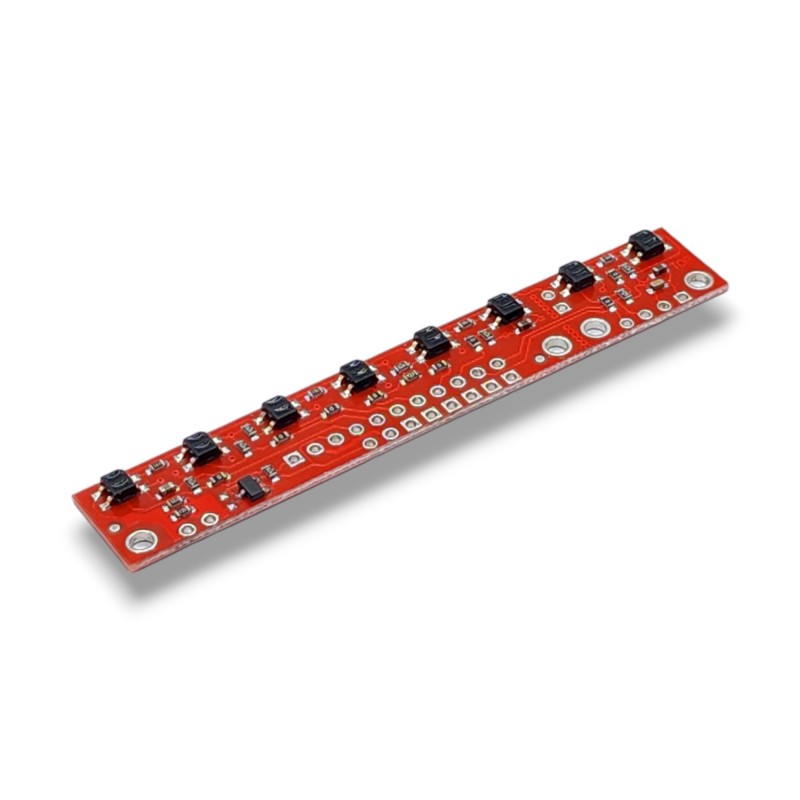
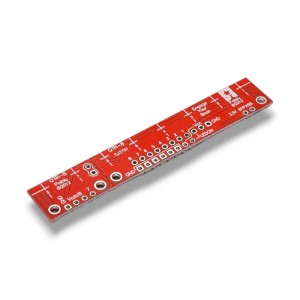
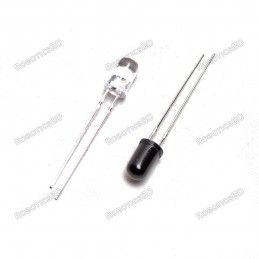
The QTR-8A Reflectance Sensor Array is a versatile module designed for robotics and embedded projects requiring accurate line, edge, or reflectance detection. Featuring eight infrared emitter and phototransistor pairs on a compact 0.375" pitch, it delivers independent analog outputs for precise surface sensing. The onboard MOSFET allows users to toggle or modulate the IR LEDs for power efficiency and adaptive brightness control, while built-in current-limiting resistors ensure stable operation at both 5V and 3.3V systems. With a low power consumption of under 100 mA and modular analog output design, the QTR-8A is perfect for building line-following robots, position sensors, or proximity-based automation systems. Featured By RoboticsBD.
Product Images are shown for illustrative purposes only and may differ from the actual product.
RoboticsBD RoboticsBD RoboticsBD RoboticsBD RoboticsBD RoboticsBD RoboticsBD RoboticsBD RoboticsBD RoboticsBD
Features:
8 IR LED/phototransistor pairs for multi-point line detection.
Independent analog outputs for flexible sensor data processing.
Compact 0.375" pitch ensures accurate detection of edges and patterns.
MOSFET LED control allows complete shutdown or PWM modulation.
Dual voltage support (5V/3.3V) with simple bypass configuration.
Energy-efficient design with paired LEDs reducing total current draw.
Durable PCB module suitable for continuous use in robotics and automation.
RoboticsBD RoboticsBD RoboticsBD RoboticsBD RoboticsBD RoboticsBD RoboticsBD RoboticsBD RoboticsBD RoboticsBD
Applications:
Line-following robots and autonomous vehicles.
Position tracking for robotic arms and CNC machines.
Proximity and edge detection in automation systems.
Reflectance measurement for object/material identification.
Educational robotics kits and DIY maker projects.
RoboticsBD RoboticsBD RoboticsBD RoboticsBD RoboticsBD RoboticsBD RoboticsBD RoboticsBD RoboticsBD RoboticsBD
| General Specifications |
| Sensor Type | IR LED + Phototransistor Array |
| Number of Channels | 8 independent analog outputs |
| Sensor Pitch | 0.375" (9.525 mm) |
| Operating Voltage | 5V (default), 3.3V with bypass |
| LED Control | MOSFET (ON/OFF, PWM support) |
| LED Current Consumption | ~20–25 mA (total < 100 mA) |
| Output Type | Analog voltage (0V to VIN) |
| Typical Use | Line following, proximity, reflectance sensing |
| PCB Features | Current-limiting resistors, power-saving LED control |
| Shipment Weight | 0.0064 kg |
| Shipment Dimensions | 10 × 10 × 3 cm |
Please allow 5% measuring deviation due to manual measurement.
RoboticsBD RoboticsBD RoboticsBD RoboticsBD RoboticsBD RoboticsBD RoboticsBD RoboticsBD RoboticsBD RoboticsBD
Documentation:
Functional Description
The QTR-8A reflectance sensor array is intended as a line sensor, but it can be used as a general-purpose proximity or reflectance sensor. The module is a convenient carrier for eight IR emitter and receiver (phototransistor) pairs evenly spaced at intervals of 0.375" (9.525 mm). Each phototransistor is connected to a pull-up resistor to form a voltage divider that produces an analog voltage output between 0 V and VIN (which is typically 5 V) as a function of the reflected IR. Lower output voltage is an indication of greater reflection.
The outputs are all independent, but the LEDs are arranged in pairs to halve current consumption. The LEDs are controlled by a MOSFET with a gate normally pulled high, allowing the LEDs to be turned off by setting the MOSFET gate to a low voltage. Turning the LEDs off might be advantageous for limiting power consumption when the sensors are not in use or for varying the effective brightness of the LEDs through PWM control.
The LED current-limiting resistors for 5 V operation are arranged in two stages; this allows a simple bypass of one stage to enable operation at 3.3 V. The LED current is approximately 20-25 mA, making the total board consumption just under 100 mA. The schematic diagram of the module is shown below:
Note: This product was imported from a third party. While it features the Pololu logo and matches the image shown, we cannot guarantee that it was manufactured by Pololu.

Interfacing with the QTR-8A Outputs
There are several ways you can interface with the QTR-8A outputs:
- Use a microcontroller’s analog-to-digital converter (ADC) to measure the voltages.
- Use a comparator with an adjustable threshold to convert each analog voltage into a digital (i.e. black/white) signal that can be read by the digital I/O line of a microcontroller.
- Connect each output directly to a digital I/O line of a microcontroller and rely upon its internal comparator.
This last method will work if you are able to get high reflectance from your white surface as depicted in the left image, but will probably fail if you have a lower-reflectance signal profile like the one on the right.

QTR-1A output 1/8" away from a spinning white disk with a black line on it.

QTR-1A output 3/8" away from a spinning white disk with a black line on it.
Pololu AVR library provides functions that make it easy to use these sensors/ please see the QTR Reflectance Sensors section of our library command reference for more information. We also have a Arduino library for these sensors.
Breaking the Module in Two
If you don’t need or cannot fit all eight sensors, you can break off two sensors and still use all 8 sensors as two separate modules, as shown below. The PCB can be scored from both sides along the perforation and then bent until it snaps apart. Each of the two resulting pieces will function as an independent line sensor.

If you need the clone version QTR Sensor:
Click Here
If you need the QTR-8A Sensor:
Click Here
Package Includes:
1 x QTR-8A Reflectance Sensor Array
RoboticsBD RoboticsBD RoboticsBD RoboticsBD RoboticsBD RoboticsBD RoboticsBD RoboticsBD RoboticsBD RoboticsBD
RoboticsBD RoboticsBD RoboticsBD RoboticsBD RoboticsBD RoboticsBD RoboticsBD RoboticsBD RoboticsBD RoboticsBD