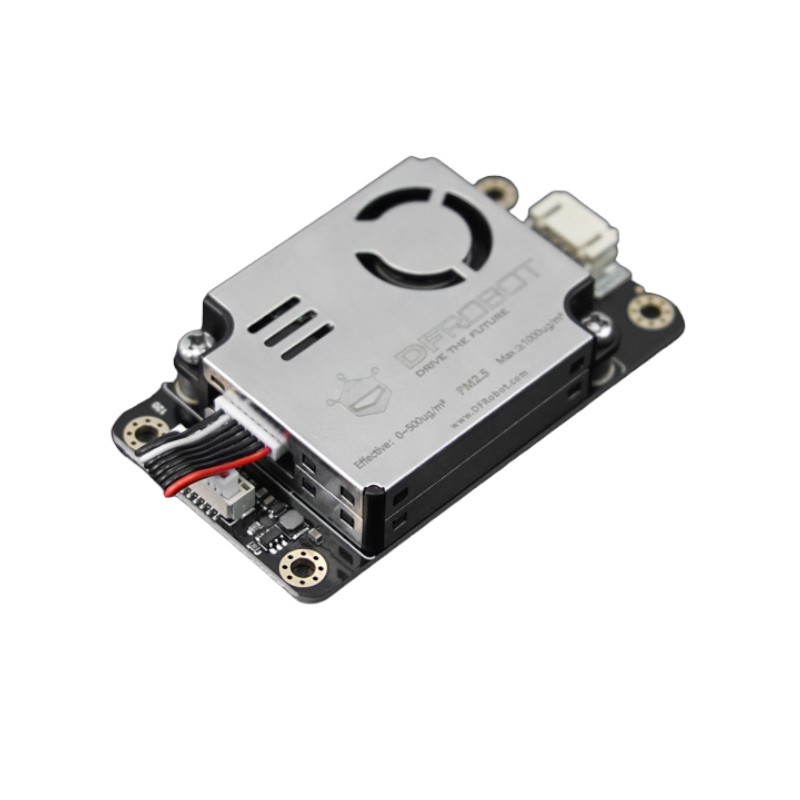
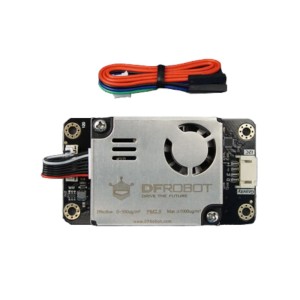
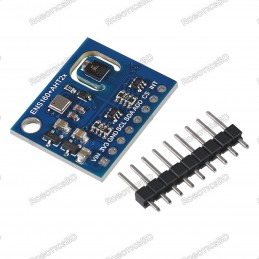
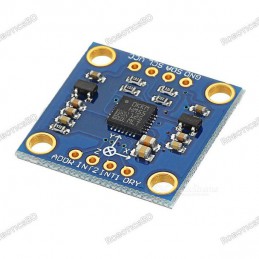
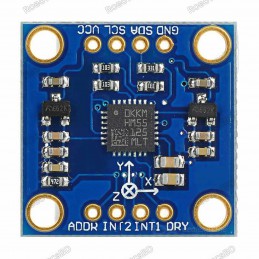
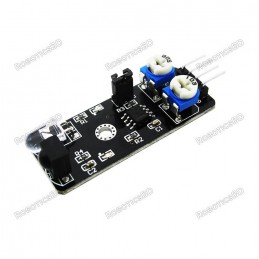
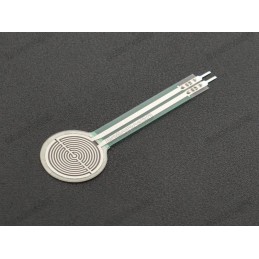
The Gravity: PM2.5 Air Quality Sensor is a high-precision digital particle sensor designed for real-time monitoring of particulate matter such as PM1.0, PM2.5, and PM10. Using the principle of laser scattering, it captures suspended particles in the air and calculates particle size and concentration with high accuracy. The sensor provides reliable output via the I2C interface, making it easy to integrate with Arduino, Raspberry Pi, and other controllers using the Gravity interface. With a minimum recognizable particle size of 0.3µm, strong anti-interference shielding, and a quick response time of less than 1 second, it ensures accurate air quality readings. Compact and ultra-thin, this sensor is ideal for portable air monitors, smart home devices, environmental improvement equipment, and educational projects. Featured By RoboticsBD.
Product Images are shown for illustrative purposes only and may differ from the actual product.
RoboticsBD RoboticsBD RoboticsBD RoboticsBD RoboticsBD RoboticsBD RoboticsBD RoboticsBD RoboticsBD RoboticsBD
Features:
Laser Scattering Technology – Accurate detection of PM1.0, PM2.5, and PM10.
Fast & Reliable – Single response time <1s, continuous real-time monitoring.
High Sensitivity – Detects particles as small as 0.3µm with high efficiency.
Low False Alarm Rate – Stable performance with strong anti-interference shielding.
I2C Interface – Easy integration with Arduino, Raspberry Pi, and other MCUs.
Compact Design – Slim 12mm body, suitable for portable and embedded systems.
Long Lifespan – MTBF of ≥5 years for reliable long-term use.
RoboticsBD RoboticsBD RoboticsBD RoboticsBD RoboticsBD RoboticsBD RoboticsBD RoboticsBD RoboticsBD RoboticsBD
Applications:
Air Quality Monitoring – Track PM2.5 and other pollutants in real time.
Smart Devices – Use in air purifiers, smart homes, and HVAC systems.
Environmental Projects – Measure pollution in cities, factories, or labs.
Health & Safety – Monitor air quality in smoking rooms, kitchens, and offices.
Educational Use – Ideal for students and researchers learning about air pollution.
RoboticsBD RoboticsBD RoboticsBD RoboticsBD RoboticsBD RoboticsBD RoboticsBD RoboticsBD RoboticsBD RoboticsBD
| General Specifications |
| Working Voltage | 3.3V – 5V |
| Max Working Current | 100mA |
| Standby Current | ≤2mA |
| Interface | I2C Digital Output |
| Particle Measurement Range | 0.3~1.0μm, 1.0~2.5μm, 2.5~10μm |
| Counting Efficiency | 50% @0.3μm, 98% @≥0.5μm |
| PM2.5 Concentration Range | 0–500 µg/m³ (effective), ≥1000 µg/m³ (max) |
| Resolution | 1 µg/m³ |
| Accuracy | ±10% @100–500 µg/m³; ±10 µg/m³ @0–100 µg/m³ |
| Response Time | <1s (single), ≤10s (comprehensive) |
| Working Temperature | -10℃ to +60℃ |
| Humidity Range | 0–95% (non-condensing) |
| MTBF | ≥5 years |
| Dimensions | 67 × 40 × 14 mm |
| Shipment Weight | 0.0122 kg |
| Shipment Dimensions | 7 × 3 × 3 cm |
Please allow 5% measuring deviation due to manual measurement.
RoboticsBD RoboticsBD RoboticsBD RoboticsBD RoboticsBD RoboticsBD RoboticsBD RoboticsBD RoboticsBD RoboticsBD
Documentation:
DFRobot brings you this Air Quality Sensor that can measure particulate matter like PM2.5, PM1.0, PM10.
With easy-to-use Gravity interface, the air quality sensor works well with most main-controllers. And we provide you with relevant sample codes to help you quickly build up air quality monitoring projects.
Based on the principle of laser scattering, the PM2.5 air quality sensor employs a digital universal particle sensor that can continuously collect and calculate the number of suspended particles of different sizes in the air per unit volume, which is particle concentration distribution, and then convert to concentration and output via I2C interface.
The sensor can be embedded in various instruments and meters or environmental improvement equipment related to the concentration of suspended particulate matter in the air to provide timely and accurate concentration data.
It is typically suitable for smoking rooms, kitchens, hot springs, bathrooms and other environments.

RoboticsBD RoboticsBD RoboticsBD RoboticsBD RoboticsBD RoboticsBD RoboticsBD RoboticsBD RoboticsBD RoboticsBD
How does the sensor work?
This sensor adopts the principle of laser scattering, that is, to make the laser irradiate the suspended particles in the air to produce scattering, and at the same time collect the scattered light at a certain angle, and obtain the curve of the intensity of the scattered light with time. Furthermore, the microprocessor, based on the MIE theory algorithm, obtains the equivalent particle size of the particles and the number of particles of different particle sizes per unit volume.

RoboticsBD RoboticsBD RoboticsBD RoboticsBD RoboticsBD RoboticsBD RoboticsBD RoboticsBD RoboticsBD RoboticsBD
DOCUMENTS
RoboticsBD RoboticsBD RoboticsBD RoboticsBD RoboticsBD RoboticsBD RoboticsBD RoboticsBD RoboticsBD RoboticsBD
Package Includes:
1 x Gravity: PM2.5 Air Quality Sensor
RoboticsBD RoboticsBD RoboticsBD RoboticsBD RoboticsBD RoboticsBD RoboticsBD RoboticsBD RoboticsBD RoboticsBD
RoboticsBD RoboticsBD RoboticsBD RoboticsBD RoboticsBD RoboticsBD RoboticsBD RoboticsBD RoboticsBD RoboticsBD