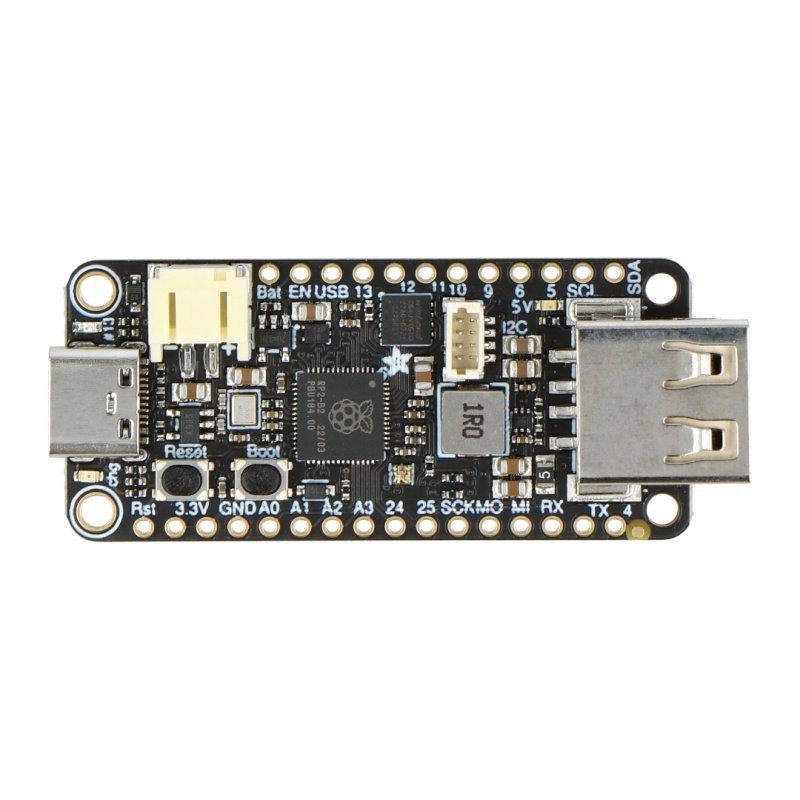
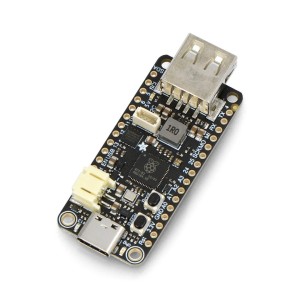
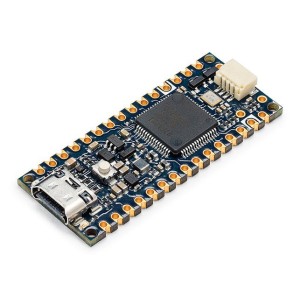
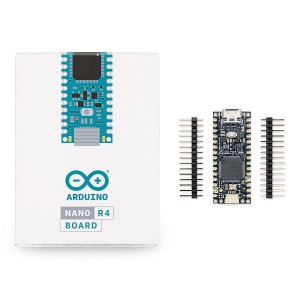
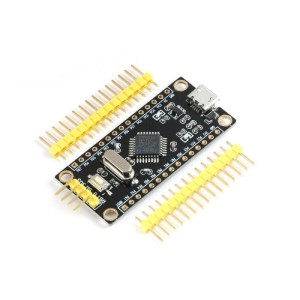
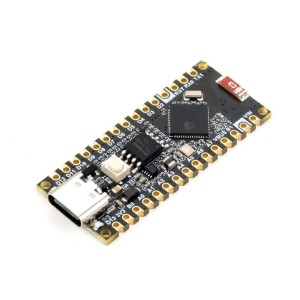
This compact Feather-format development board is built around the RP2040 microcontroller and includes both a USB-C device port and a USB Type-A host port. The host port allows you to connect USB peripherals such as flash drives, keyboards, HID devices, or other microcontrollers, enabling advanced project possibilities in a small and efficient footprint.
Although the RP2040 does not include native USB host hardware, the board uses the RP2040’s PIO system and supporting firmware techniques to emulate USB host functionality. This allows one USB port to continue functioning for programming and debugging, while the second port communicates with external USB devices.
Support for USB Host operation is available through libraries in Arduino or CircuitPython, enabling applications such as datalogging to a USB drive, using external HID devices, sending data to another serial-based USB device, and more.
A built-in 5V boost converter provides up to 1A peak output, making it suitable for powering USB peripherals directly from a Li-Ion/Li-Po battery. Power to the USB device can be switched via a dedicated GPIO pin for resetting or controlling attached hardware.
The board also includes a STEMMA QT / Qwiic-compatible connector for plug-and-play I2C expansion modules, onboard battery charging circuitry, and a compact layout ideal for prototyping or portable builds.
Features
RP2040 dual-core Cortex-M0+ microcontroller running at 133 MHz
264 KB RAM
8 MB onboard SPI flash memory
USB-C port for programming and data
USB Type-A port for USB Host mode (D+ on GPIO16, D– on GPIO17)
5V boost converter (up to 1A peak) for powering USB peripherals
500 mA resettable fuse on USB power
Lithium-polymer battery connector with onboard charging
STEMMA QT / Qwiic-compatible I2C connector
21 multifunction GPIO pins, including:
4 × 12-bit ADC channels
2 × I2C
2 × SPI
2 × UART
16 × PWM outputs
RGB NeoPixel indicator LED
User LED on pin 13
Reset and bootloader buttons
3.3V regulator with up to 500 mA peak output
12 MHz crystal for precise timing
Feather-format mounting holes (4 total)
Specifications
Dimensions:
56.3 mm × 22.8 mm × 8.7 mm