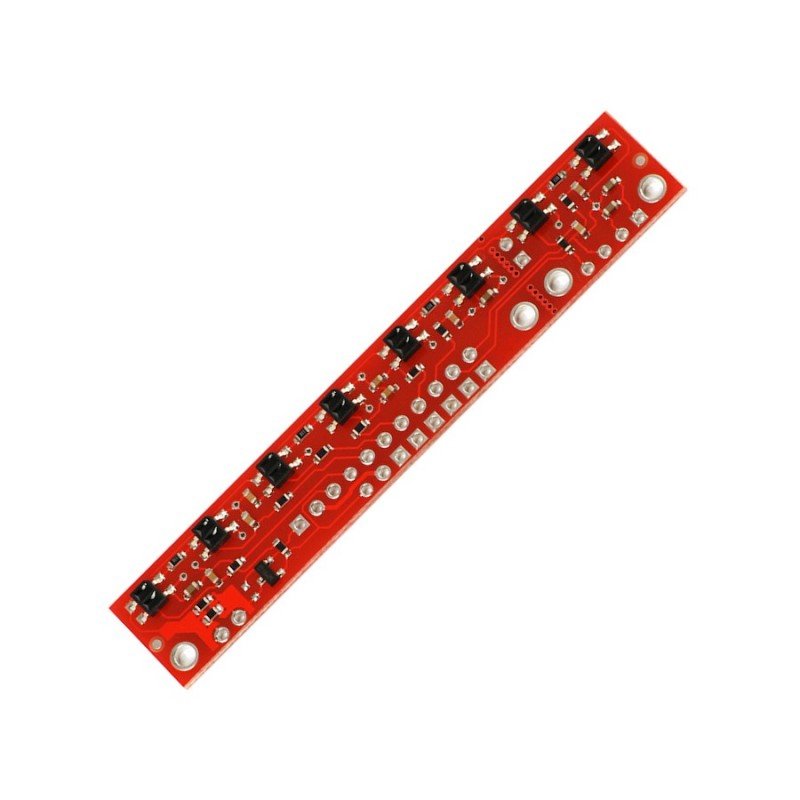
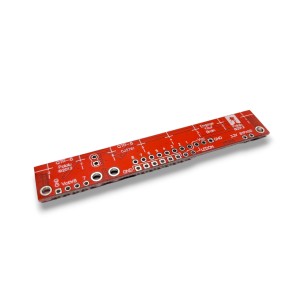
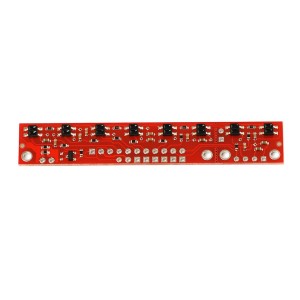
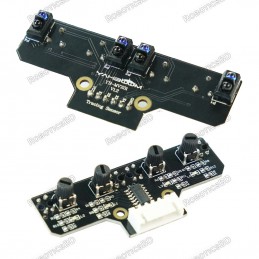
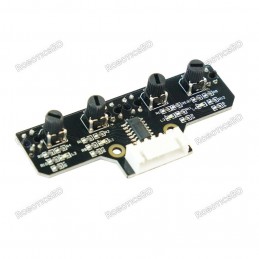
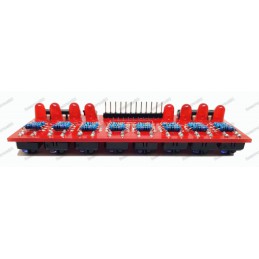
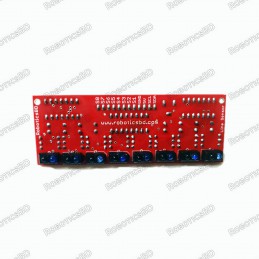
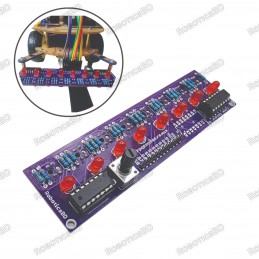
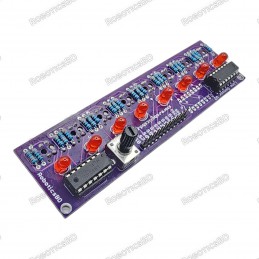
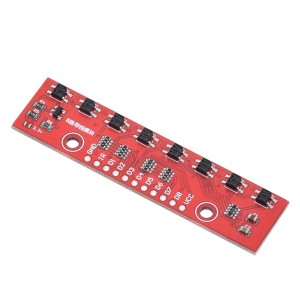
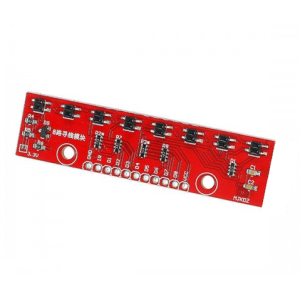
The QTR-8RC Reflectance Sensor Array is a versatile and cost-effective module designed for line-following robots and general-purpose reflectance or proximity detection. Featuring eight IR LED/phototransistor pairs on a 9.525mm pitch, this module outputs digital I/O-compatible signals that can be easily read by most microcontrollers without requiring an ADC. Its unique design enables reduced power consumption by arranging LEDs in pairs and allowing them to be controlled via MOSFET switching or PWM for brightness adjustment. With operating support for both 3.3V and 5V systems, fast sampling capability up to 1kHz, and compact dimensions, this sensor array is an excellent choice for robotics enthusiasts, students, and makers seeking reliable performance in line tracking and object detection applications. Imported from China (clone version, not confirmed Pololu). Featured By RoboticsBD.
Product Images are shown for illustrative purposes only and may differ from the actual product.
RoboticsBD RoboticsBD RoboticsBD RoboticsBD RoboticsBD RoboticsBD RoboticsBD RoboticsBD RoboticsBD RoboticsBD
Features:
Eight independent IR sensors for accurate line detection and reflectance measurements.
Digital output format – eliminates need for an ADC, simplifying integration with microcontrollers.
Low power consumption design with paired LEDs and MOSFET-controlled switching.
Flexible operating voltage (3.3V–5V) suitable for a wide range of controllers and robotics platforms.
Fast sampling rate up to 1kHz for high-speed applications.
Compact and lightweight build – easy to integrate into small robotic platforms.
RoboticsBD RoboticsBD RoboticsBD RoboticsBD RoboticsBD RoboticsBD RoboticsBD RoboticsBD RoboticsBD RoboticsBD
Applications:
Line-following robots for competitions, education, or automation projects.
Proximity and reflectance sensing in robotics and embedded electronics.
Maze-solving robots that require accurate path detection.
DIY automation projects requiring low-cost, efficient sensing.
STEM education kits for hands-on learning in sensor-based robotics.
RoboticsBD RoboticsBD RoboticsBD RoboticsBD RoboticsBD RoboticsBD RoboticsBD RoboticsBD RoboticsBD RoboticsBD
| General Specifications |
| Module type | QTR-8RC Reflectance Sensor Array |
| Number of sensors | 8 (IR LED/phototransistor pairs) |
| Pitch between sensors | 0.375" (9.525mm) |
| Operating voltage | 3.3V – 5.0V |
| Supply current | ~100mA (typical), reduced with LED control |
| Output format | 8 digital I/O-compatible signals |
| Optimal sensing distance | 0.125" (3mm) |
| Max sensing distance | 0.375" (9.5mm) |
| Board dimensions | 2.95" × 0.5" × 0.125" |
| Weight (without headers) | 3.09g |
| LED current | 20–25mA (per LED pair) |
| Sampling frequency | Up to 1kHz |
| Shipment Weight | 0.0055 kg |
| Shipment Dimensions | 10 × 3 × 2 cm |
Please allow 5% measuring deviation due to manual measurement.
RoboticsBD RoboticsBD RoboticsBD RoboticsBD RoboticsBD RoboticsBD RoboticsBD RoboticsBD RoboticsBD RoboticsBD
Documentation:
Functional Description
The QTR-8RC reflectance sensor array is intended as a line sensor, but it can be used as a general-purpose proximity or reflectance sensor. The module is a convenient carrier for eight IR emitter and receiver (phototransistor) pairs evenly spaced at intervals of 0.375" (9.525 mm). To use a sensor, you must first charge the output node by applying a voltage to its OUT pin. You can then read the reflectance by withdrawing that externally applied voltage on the OUT pin and timing how long it takes the output voltage to decay due to the integrated phototransistor. Shorter decay time is an indication of greater reflection. This measurement approach has several advantages, especially when coupled with the ability of the QTR-8RC module to turn off LED power:
No analog-to-digital converter (ADC) is required
Improved sensitivity over voltage-divider analog output
Parallel reading of multiple sensors is possible with most microcontrollers
Parallel reading allows optimized use of LED power enable option
The outputs are all independent, but the LEDs are arranged in pairs to halve current consumption. The LEDs are controlled by a MOSFET with a gate normally pulled high, allowing the LEDs to be turned off by setting the MOSFET gate to a low voltage. Turning the LEDs off might be advantageous for limiting power consumption when the sensors are not in use or for varying the effective brightness of the LEDs through PWM control.
This sensor was designed to be used with the board parallel to the surface being sensed.
The LED current-limiting resistors for 5 V operation are arranged in two stages; this allows a simple bypass of one stage to enable operation at 3.3 V. The LED current is approximately 20–25 mA, making the total board consumption just under 100 mA. The schematic diagram of the module is shown below:
Note: This product was imported from a third party. While it features the Pololu logo and matches the image shown, we cannot guarantee that it was manufactured by Pololu.

RoboticsBD RoboticsBD RoboticsBD RoboticsBD RoboticsBD RoboticsBD RoboticsBD RoboticsBD RoboticsBD RoboticsBD
Interfacing the QTR-8RC Outputs to Digital I/O Lines
The QTR-8RC module has eight identical sensor outputs that, like the Parallax QTI, require a digital I/O line capable of driving the output line high and then measuring the time for the output voltage to decay. The typical sequence for reading a sensor is:
- Turn on IR LEDs (optional).
- Set the I/O line to an output and drive it high.
- Allow at least 10 μs for the sensor output to rise.
- Make the I/O line an input (high impedance).
- Measure the time for the voltage to decay by waiting for the I/O line to go low.
- Turn off IR LEDs (optional).
These steps can typically be executed in parallel on multiple I/O lines.
With a strong reflectance, the decay time can be as low as several dozen microseconds; with no reflectance, the decay time can be up to a few milliseconds. The exact time of the decay depends on your microcontroller’s I/O line characteristics. Meaningful results can be available within 1 ms in typical cases (i.e. when not trying to measure subtle differences in low-reflectance scenarios), allowing up to 1 kHz sampling of all 8 sensors. If lower-frequency sampling is sufficient, substantial power savings can be realized by turning off the LEDs. For example, if a 100 Hz sampling rate is acceptable, the LEDs can be off 90% of the time, lowering average current consumption from 100 mA to 10 mA.

RoboticsBD RoboticsBD RoboticsBD RoboticsBD RoboticsBD RoboticsBD RoboticsBD RoboticsBD RoboticsBD RoboticsBD
Package Includes:
1 x QTR-8RC Reflectance Sensor Array
RoboticsBD RoboticsBD RoboticsBD RoboticsBD RoboticsBD RoboticsBD RoboticsBD RoboticsBD RoboticsBD RoboticsBD
RoboticsBD RoboticsBD RoboticsBD RoboticsBD RoboticsBD RoboticsBD RoboticsBD RoboticsBD RoboticsBD RoboticsBD